Showing posts with label Ruhollah. Show all posts

Monday, July 31, 2017

Evin Prison: The Iranian regime’s notorious torture factory


By Tony Duheaume 
Special to Al Arabiya EnglishSunday,
sunday, 30 July 2017 


The Iranian regime lives in constant fear of an uprising to overthrow it. Such is its paranoia where opposition groups are concerned it has spent the whole period of its existence, eliminating dissenters.

The approach to any form of opposition shows how insecure this regime has become. But as far as extreme brutality is concerned, it could not be more prevalent than that of the regime’s treatment of dissidents at Evin Prison, where guards use torture to humiliate their captives before executing them.

Through the despicable acts taking place here, the lack of humanity shown by the prison authorities toward all those who speak out against the regime, mirrors the insecurities of the entire state.

Located at the foot of the Alborz mountains in northern Tehran, Evin Prison was originally constructed in 1972, under the reign of Mohammad Reza Pahlavi. It was then operated by his infamous security and intelligence service (SAVAK).

Opponents of the Shah


Opponents of the Shah
Thousands of political prisoners were incarcerated there during that period, including many supporters of the Peoples Mojahedin Organisation of Iran (PMOI/MEK), fierce opponents of the Shah, and it was from this point on, its reputation of hell on earth had begun.

With Evin Prison being one of the most notorious prisons in the world, just the mention of its name conjures up emotions of fear and foreboding in the hearts of ordinary Iranian citizens, as it has become synonymous with political repression, mass hangings and torture.

This infamous place is where those entering find themselves at the mercy of brutal prison guards, who at this point in time, operate under the control of the Islamic Republic of Iran’s Secret Service (VAVAK).
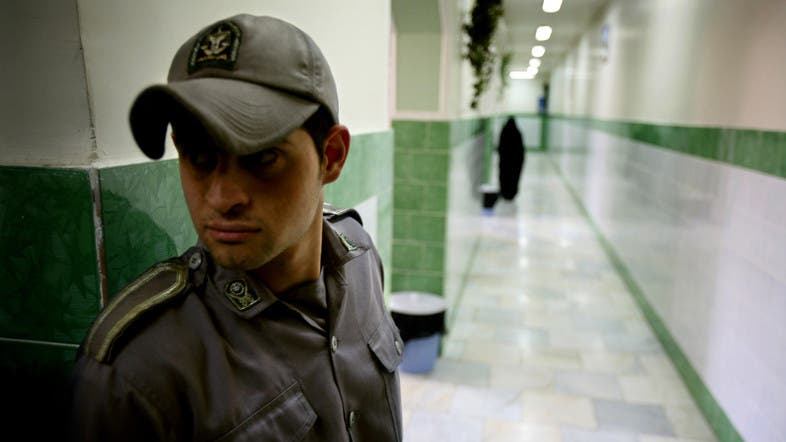
Female prison guards walk along a corridor in Tehran's Evin prison June 13, 2006. (Reuters)

No legal representation


Female prison guards walk along a corridor in Tehran's Evin prison June 13, 2006. (Reuters)

No legal representation
Teachers, writers, journalists, students, lawyers and academics, in fact anyone who speaks out against the regime, can find themselves thrown into Evin Prison. After trials without legal representation, the accused are found guilty of vague crimes on erroneous evidence, and are either condemned to serve long prison sentences.

Although the Iranian regime has continuously denied it, Evin Prison is known to be a virtual torture factory, where countless numbers of inmates have met their fate. Due to the number of intellectuals imprisoned within its walls, the prison has been nicknamed Evin University.

With Evin being a prison that is extremely overcrowded, hygiene is poor and in Iran’s sweltering hot summers, the heat can reach up to 45 degrees Celsius. There is no form of air conditioning, and the air within cells becomes rank with sweat and human waste. Water quality is bad and food comes in meagre portions and is barely edible. Medical facilities are virtually non-existent.

Breaking resolve


Breaking resolve
This whole process is designed to break the resolve of political prisoners, where the pressure for a confession is kept up until the captive breaks his silence. Then designed to add to this anguish, all contact with the outside world is cut off, family visits and telephone calls are forbidden, and even the guards are ordered to be silent.

Countless numbers have been driven insane by this treatment, many smashing their heads against the wall of their cell in anguish, while others have attempted suicide, but such is the security at Evin, no prisoner has been known to have escaped.

Inside Evin’s fetid dungeons, there are vents on the wall opposite the window, where a sturdy metal door stands, and at the bottom of the door is fitted a flap, for the prison guard to slide food through to the prisoner, while at the top of the door there is a flap used for communication.

One group of prisoners that has suffered the most at Evin Prison is the PMOI/MEK, thousands of its members have been held there over the years since the revolution.
Iranian women prisoners sit inside their cell in Tehran's Evin prison June 13, 2006. (Reuters)

The 1988 massacre


Iranian women prisoners sit inside their cell in Tehran's Evin prison June 13, 2006. (Reuters)

The 1988 massacre
With countless numbers having been incarcerated at the time of the now infamous 1988 massacre, thousands of their number can be added to the 30,000 dissidents that were murdered across Iran. This was done under the orders of the then Supreme Leader Ruhollah Khomeini to execute all those who opposed his regime.

After the execution, corpses would be transported in the dead of night to one of the numerous mass graves, which came in the form of deeply dug channels, secretly excavated in various isolated locations across the country, areas dubbed by their executioners as Lanat-Abad (The Place of the Damned).

But to this very day, nothing has changed at Evin. Untold abuses still take place, while the words of human rights activists fall on deaf ears. Rather than denouncing the regime with the harsh condemnation it rightly deserves, the world has virtually ignored the abuses carried out in its prisons and on its streets, offering the leadership more in the way of lucrative transactions like the Iran Deal, rather than that of hard-hitting sanctions that cut deep.

Disclaimer: Views expressed by writers in this section are their own and do not reflect Al Arabiya English's point-of-view.


Monday, July 10, 2017

Iran Acknowledges Massacre of Political Prisoners

“It is not easy to keep silent when the silence is a lie.”
Victor Hugo - Les Miserables
For three decades Iran lied about the massacre of 30,000 political prisoners in summer of 1988, and kept silent about this atrocity. But in this year’s presidential election as conservative cleric Ebrahim Raisie, one of the perpetrators of the massacre, was selected as one of the main candidates, the issue surfaced, forcing regime officials, one after another, to confess about the carnage.
“Executions in 1988 were fair and legal…[Iranian regime founder Ruhollah] Khomeini carried out a measure no other clergy was able to throughout history …Khomeini was decisive and had no reservations over God’s will, and God’s will was that all enemies of God must be executed…Imam (Khomeini) did not pay any attention to the West’s human rights claims… At the time 80 to 90 percent of high school and university students supported opposition groups. We started the trails and after convicting them, in a period of two to three months the card was turned around… my friends and I, all together we were 20 judges in the country, and we carried out something that guaranteed the security of the country for that year and the years to come, so the MEK can never rise again, because in a period that they were getting strong we suffocated them.” said Mullah Ali Razini, prosecutor of branch 41 of Iran’s Supreme Court, about the 1988 massacre in his July 2nd interview with the semi-official Tasnim news agency.
In the summer of 1988 Khomeini issued a religious decree calling for the massacre.
“Whoever at any stage continues to belong to the [People’s Mojahedin Organization of Iran (PMOI/MEK)] must be executed. Annihilate the enemies of Islam immediately!…Those who are in prisons throughout the country and remain steadfast in their support for the MEK are waging war on God, and are condemned to execution…It is naive to show mercy to those who wage war on God,” reads part of the decree.
A committee of four men was formed to implement the order, and in a matter of few months over 30,000 political prisoners were executed, mostly members and supporters of the main opposition PMOI/MEK.
Last year the revelation of an audio tape and unpublished letters of the late Ayatollah Hossein-Ali Montazeri, former successor to Khomeini, shed light on new dimensions of this great crime. Pregnant women and girls as young as 14 and 15 years old were among those executed, Montazeri wrote.
“A full accounting of what’s called the “death commission” created by Khomeini has yet to be carried out. But thousands died — by hanging or firing squad or in places such as Tehran’s Evin prison,” according to a 1990 Amnesty International report.
The families of the victims had been imprisoned, tortured and suppressed not to ask about their loved ones.
“Prisoner of conscience Maryam Akbari Monfared has been threatened with an additional three-year prison term and exile to a remote prison. This was in reprisal for her open letters seeking truth and justice for her siblings who were extrajudicially executed in 1988. She has been held in Tehran’s Evin prison since 2009 serving a 15-year sentence,” Amnesty reported on 3 November 2016.
In another report in 2009, Amnesty called on “Iranian authorities to immediately stop the destruction of hundreds of individual and mass, unmarked graves in Khavaran, south Tehran, to ensure that the site is preserved and to initiate a forensic investigation at the site as part of a long-overdue, thorough, independent and impartial investigation into mass executions which began in 1988, often referred to in Iran as the ‘prison massacres’. The organization fears that these actions of the Iranian authorities are aimed at destroying evidence of human rights violations and depriving the families of the victims of the 1988 killings of their right to truth, justice and reparation.”
All we hear in the West is about Iran’s nuclear and missile programs, and their malignant actions in the neighboring countries. For far too long the West has turned a blind eye to Iran’s atrocious human rights violations.
Marking the 29th anniversary of this horrific purge, the time has come to hold the mullah’s regime accountable for crimes against humanity.


Friday, June 30, 2017

IRAN'S "WAR AGAINST TERRORISTS" SHOULD NOT DECEIVE THE WEST


INU - It was recently announced that Iran’s Revolutionary Guards fired mid-range missiles from western Iran into the Deir-es-Zour region of eastern Syria. Allegedly, this was a response to a “war against terrorists”. However, even before the missile strike, the Iranian authorities were using the June 7th terrorist attack on the Iranian parliament building and the mausoleum of Islamic Republic founder Ruhollah Khomeini to portray themselves as both an opponent of, and target for, global terrorism.
Alejo Vidal-Quadras, former vice-president of the European Parliament from 1999 to 2014 and current president of the Brussels-based International Committee in Search of Justice (ISJ) writes in his article for Euractiv, that “Nothing could be further from the truth.”
Maryam Rajavi, president-elect of the National Council of Resistance of Iran (NCRI), has said that “the founder and the number one state sponsor of terror is trying the switch the place of murderer and victim and portray as such the central banker of terrorism. The real victims of these vicious actions are the innocent people killed or wounded that deserve indeed our solidarity, and not the most cruel and oppressive regime of the planet.”
Vidal-Quadras says that her statement places this “in the context of a broader Iranian project of trying to overcome the country’s economic and political isolation without compromising on its violent and destabilising activities in the region and the world.”
The Iranian regime’s response to the Tehran attacks is linked to the lightly enforced 2015 nuclear agreement that enforced restrictions on country’s nuclear enrichment program in exchange for relief from economic sanctions.
The agreement encouraged a number of European policymakers and business leaders to begin expanded relations with the Islamic Republic, despite the failure to address such items as the moderation of Iranian human rights behavior and tensions between the Islamic Republic and the West.
Many of the advocates of trade deals and normalization may view the Tehran attacks with favor. Vidal-Quadras poses that this may be used as justification: “If Iran is a target for ISIS, they might argue, surely it can also be an asset in helping to defeat the Sunni terrorist group. If that’s the case, what harm could come of doing business with Iran and providing its government with an economic boost as its fight aids in the defeat of terrorists?”
The recent ISIS attacks change nothing about the Iranian regime’s history, ideology, or conduct. Since the 1979 popular revolution, that regime, and in particular its Islamic Revolutionary Guards Corps (IRGC), has been a force behind Islamic extremism. He says, “Sometimes it has even fuelled Sunni extremism by encouraging the alienation of Sunni populations overall, as it has done in the ISIS hotbeds of Syria and Iraq, where Shiite militants with the IRGC’s backing run roughshod over the country.”
But most important is that many of these militant groups have been accused of human rights violations.
The international community must remember that any expansion in economic, political, or security cooperation with Tehran will be a deal with a regime that represses the Iranian people, and executed dissidents and activists, including 30,000 political prisoners, mostly from the opposition group PMOI (MEK), in the summer of 1988.
Iran’s record will be explained on July 1st, when the NCRI holds its annual Iran Freedom rally in Paris to endorse regime change. Hundreds of European and American politicians will attend the event, as well as tens of thousands of expat Iranians. The US and its global partners will be urged to blacklist the IRGC as a terrorist organisation.
“The task thereafter will be to convince Western governments to set policy in accordance with the notion that Middle Eastern conflicts should not be competitions between two factions of extremists, but rather between extremism as a whole and the moderate Muslims who advocate for true democracy and freedom in their homelands,” Vidal-Quadras concludes.

Tuesday, June 27, 2017

ANALYSIS: Is Iran plunging the Middle East into another war?

An Iranian soldier stands guard during a ceremony marking the 37th anniversary of the Revolution, in Tehran, February 11, 2016. (Reuters)
The days of ISIS are numbered and voices are heard about the entire region being forced into a far more disastrous conflict. Various parties, mainly the US and Iran, have begun jostling, seeking to inject their influence onto what the future holds for Syria.
As Iran has also wreaked havoc in Iraq and Yemen, concerns are rallying on Tehran going the distance to pull the US full-scale into the Syria inferno. Such a mentality results from misunderstanding the nature of what is known as the Iranian regime.

Escalating tensions

After establishing a foothold in the strategic town of al-Tanf near the Iraq-Jordan-Syria border, US forces designated a buffer zone to provide protection for their own troops and resources, alongside their allies of anti-Assad opposition rebels.
1) On three different incidents Iran-backed militias have made advances into the buffer zone, only to receive warnings and eventually be attacked by US warplanes.
2) Raising the stakes, on two occasions Iran-made pro-Assad drones have been downed by US-led coalition forces.
3) And maybe the ultimate incident came when a US F/A-18 fighter jet shot down a Syrian Sukho-22 warplane after the latter dropped bombs on US-backed Kurdish forces north of Raqqa, the self-declared capital of ISIS.
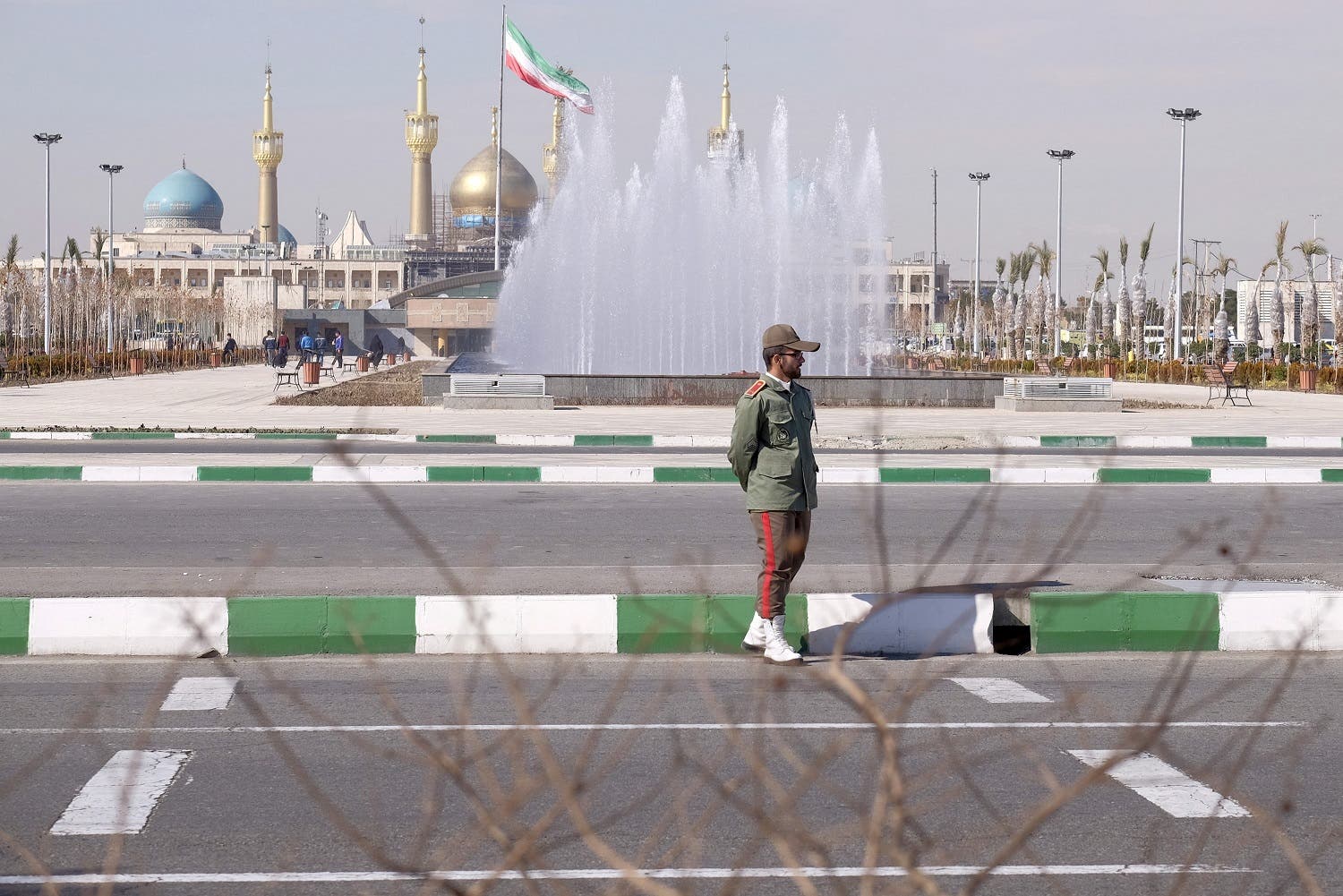
An Iranian soldier stands guard in front of the shrine of Ayatollah , Khomeini in Behesht Zahra cemetery, south of Tehran February 1, 2016. (Reuters)

Tehran’s habit

Understanding its conventional and non-conventional forces stand no match against the classical armies of the US and the unity of its Arab allies, Iran has for the past 38 years resorted to tactics of its own.
Terrorist attacks across the region through proxy groups such as the Lebanese Hezbollah have proven successful. The 1982 Beirut bombings of US and French barracks led to the American pullout of this highly fragile country. As a result, Tehran has used this method ever since to send its message. Following the wars of Afghanistan and Iraq, Iran yet again resorted to paramilitary and proxy methods to advance its interests in the region.
Seeing no strong response only emboldens Iran in its pursuit of wreaking havoc. Witnessing the disastrous and premature withdrawal of US forces from Iraq, and Obama’s refusal to live up to his own red line after Assad resorted to the extreme low of gassing his own people in 2013, Iran came to a conclusion such actions will continue unabated.

The language of force

There have been cases otherwise, however, including Operation Praying Mantis on April 18th, 1988 when the US Navy launched a campaign against Tehran’s naval fleet in retaliation for the Iranian mining of the Persian Gulf during the Iran–Iraq war and the subsequent damage to an American warship.
The attack came as a major wake-up call for Iran as the mullahs in Tehran only understand the language of force. The 59 cruise missiles the US used to target the Syrian regime airfield used to launch a chemical attack on Homs earlier this year also rose eyebrows not only in Damascus, Moscow and Tehran, but the world over.
The recent incidents in Syria are further serious signals for Iran that such belligerence no longer will go tolerated, especially considering a new US administration in Washington adopting a far different perspective and strategy than its predecessor.
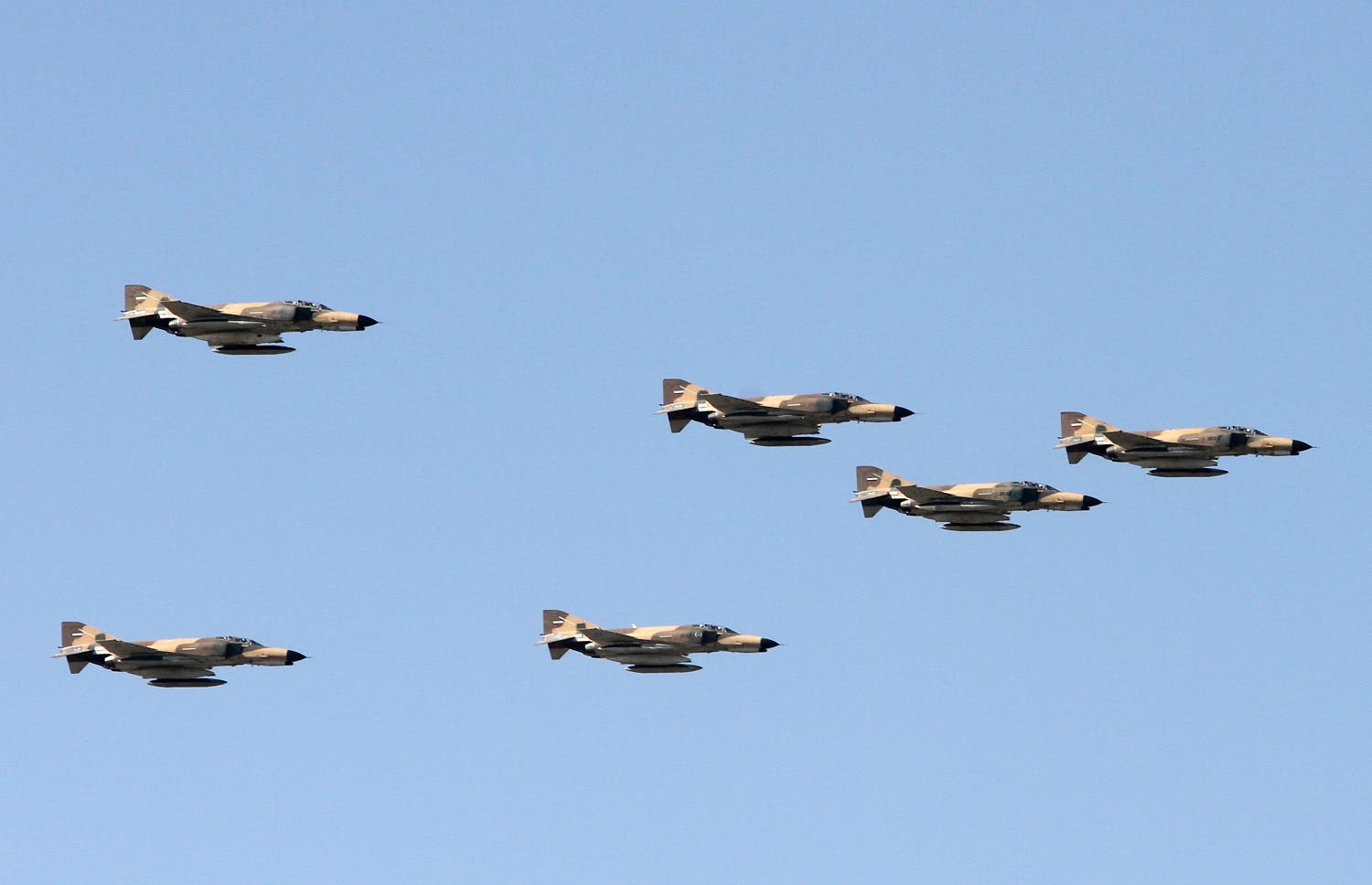
Iranian air force’s US-made F-4 Phantom fighter jets perform during a parade on the occasion of the country’s Army Day, on April 18, 2017, in Tehran. (AFP)

Solution

What needs grave understanding is the fact that Iran is the last party that seeks a full blown war in Syria, Yemen or any other region of the Middle East. The Iranian regime is seeking a win-win solution, enjoying an open hand in meddling across the region to such extent to prevent any major international community retaliatory action.
Has Iran been successful? To this day, mostly it has, unfortunately, thanks to the West’s highly flawed belief in adopting a policy of engagement with Iran to tame the mullahs and enjoy short-term economic gains.
The tides, however, are changing for the better. Iran’s Achilles Heel must be the main target as seen in the recent US Senate resolution imposing sanctions on the regime’s ballistic missile program, support of terrorism and human rights violations.
Tehran may kick, scream and threaten to abandon the Iran nuclear deal in retaliation. Yet rest assured the mullahs will not make such a grave mistake, triggering the automatic re-imposition of sanctions under six previous United Nations Security Council resolutions.
Iran’s Revolutionary Guards lies at the heart of the mullahs’ illicit activities both inside the country and abroad. This entity also controls around 40 percent of the country’s already fragile and highly corrupt economy.
To this end, there is no need for another war in the region. Iran knows better that such an outcome would only accelerate developments against its interests. The US and Arab world can and should lead the international community by designating the Revolutionary Guards as a foreign terrorist organization.
This will be a complementary measure to the abovementioned Senate resolution, and bring Tehran to its knees. Such an initiative will place the international community alongside the Iranian people in their struggle against the ruling mullahs’ regime.
This is especially true after US Secretary of State Rex Tillerson referred to Washington’s support for domestic forces seeking peaceful regime change in Iran.
Last Update: Monday, 26 June 2017 KSA 12:47 - GMT 09:47

Mattis: Delay in Syria chemical investigation ’unfortunate’

US Defense Secretary Jim Mattis Orient Net, April 19, 2018 -- US Defense Secretary Jim Mattis said on Wednesday (April 18) that a delay i...