Showing posts with label Maryam Rajavi. Show all posts

Thursday, September 14, 2017

House votes to block aircraft sales to Iran


The House adopted measures on Wednesday to prevent sales of commercial aircraft to Iran, despite warnings from some Democrats that it would undermine the international accord to curtail the country’s nuclear weapons program.

Rep. Peter Roskam (R-Ill.) offered two amendments to a 2018 government spending package that would specifically prohibit the use of funds to authorize financial transactions for the sales and prevent the Office of Foreign Assets Control from clearing licenses to allow aircraft sales.

Roskam said that the U.S. should refrain from selling the aircraft to Iran given the country’s history of using commercial aircraft to transport resources, like weapons and troops, to support President Bashar Assad in Syria.

“Until Iran ceases using commercial aircraft to support terrorists and war criminals, western companies ought not be allowed to sell Iranian airliners more aircraft that they can use to fuel Assad’s brutal war,” Roskam said during House floor debate.

Rep. Earl Blumenauer (D-Ore.) warned that blocking the sales would result in “penalizing American companies for no good purpose” and threaten the nuclear deal with Iran.

“I think being able to maintain our commitments under the agreement with the [Iran nuclear deal] is important. That Iranian nuclear agreement has held and is one of the few bright spots in that region,” Blumenauer said.

Both of Roskam’s amendments were adopted by voice votes. Similar amendments offered by Roskam were also adopted as part of a spending bill last year but did not become law.

The House additionally passed separate legislation last November to block the licenses to finance aircraft sales with Iran, but it never got a vote in the Senate.

Iran Air has ties to the Iranian Revolutionary Guard Corps, which remains sanctioned by the U.S. But Iran Air was granted sanctions relief as part of the 2015 nuclear accord, which relaxed sanctions in exchange for limits to Iran’s nuclear program.

Airbus, a European aircraft manufacturer, and Boeing, an American company, have struck multibillion-dollar deals with Iran in the last year to sell planes.

President Trump has railed against the Iran deal, but his administration has not taken steps to block the aircraft sales. Forcing a stop to the transactions could be at odds with Trump’s promotion of manufacturing jobs in the U.S., despite his vow to be tougher on Iran.
 ,  and Sen. Marco Rubio (R-Fla.) urged President Trump in April to suspend aircraft sales to Iran.


“The possibility that U.S.-manufactured aircraft could be used as tools of terror is absolutely unacceptable and should not be condoned by the U.S. government,” they wrote in a letter to Trump.


Sanctioning the Terrible Twosome


Deep military and nuclear cooperation between North Korea and Iran makes sanctions on both 
regimes all the more essential


The world currently faces two atomic crises in Iran and North Korea, despite long strides in the effort of nuclear non-proliferation. Deep military and nuclear cooperation between the two states makes dealing with these challenges even more difficult. One may have thought lessons would have been learnt from the devastating lessons of appeasement from World War II – yet the approaches adopted vis-à-vis North Korea and Iran in signing nuclear agreements have raised accusations that Neville Chamberlain’s famous policy is still alive and well.

It’s obvious that Iran has learned from North Korea, and vice-versa, in both military and diplomatic spheres: in a recent Raddington Report article we argue that there are few nations that view North Korean missile tests with more interest than Iran. The Islamic Republic yearns to be in the position North Korea finds itself in – to have developed a nuclear arsenal, along with the means of deliver the payload. And North Korea covets to have had the opportunity Iran found: usurping Obama’s desperate need for a legacy-defining foreign policy achievement to garner a slate of concessions.

There is seemingly little appetite for a military confrontation with North Korea or Iran – yet the appeasement of these two rogue regimes have left the international community in more of a quagmire. North Korea is holding South Korea and Japan hostage (along with tens of thousands of stationed US troops) while Iran continues its regional meddling, support for terrorism, ballistic missile advances and human rights violations, all whilst reaching an agreement with the P5+1.

Pyongyang and Tehran have both sought nuclear weapons as insurance for their notorious regimes. Enjoying enticement by US administrations since the 1990s, North Korea has reached its objective, at the expense of it’s starving people – and economy more broadly. Iran, whilst seeking nuclear capability, began feeling the heat of international sanctions and escalating public anger, which forced it to trade a curbing of its nuclear program in return for sanctions relief. What goes unnoticed, however, is how agreements signed by the international community with these two regimes provide a green light to the ruling autocrats to pursue the oppression of their own populations.

Iran has continued its practice of abducting American citizens and sentencing them to long prison terms. A situation in which Kim Jung Un was provided more inducements to come to the negotiating table – as in Iran’s case – could possibly result in further abductions, assassinations and more tens of thousands of political prisoners held in facilities so large they are visible in satellite images. Concessions have already provided Iran a green light to expand its domestic crackdown and meddling abroad. The definition of insanity, famously, is doing the same thing over and over again, but expecting different results.

Offering a possible insight into the Trump administration’s future approach to Iran, known as the Joint Comprehensive Plan of Action (JCPOA), Nikki Haley delivered a speech recently in the American Enterprise Institute, stating that; “…if the President does not certify Iranian compliance, the Corker-Cardin law also tells us what happens next. What happens next is significantly in Congress’s hands,” she explained, in reference to the Iran Nuclear Agreement Review Act.

“Congress could debate whether the nuclear deal is in fact too big to fail. We should welcome a debate over whether the JCPOA is in U.S. national security interests. The previous administration set up the deal in a way that denied us that honest and serious debate,” the US Ambassador to the United Nations continued.

Following Pyongyang’s latest nuclear test, which led to claims that the DPRK has acquired the ability to test a hydrogen bomb, there is belief amongst high circles in Washington that North Korea is supporting Iran in return to the path of obtaining nuclear weapons. While Washington is weighing its options in responding to North Korea’s latest nuclear bomb test, most concerning are obvious shows of allegiance, such as a recent 10-day visit to Tehran by Pyongyang’s parliament speaker Kim Yong Nam.

Thanks to a ‘windfall’ of billions of dollars provided by the Obama-blueprinted nuclear deal, Iran has the hard currency and financial assets North Korea needs. In return, Pyongyang can deliver the nuclear weapons and ballistic missile technology Tehran wants to acquire. It has become increasingly obvious these regimes are far from rational actors who can be persuaded into taking action for the better benefit of the international community. North Korea must be made to bow before demands to give up nuclear weapons, whilst Iran must be made to understand that following the path of its East Asian partner is not an option.

The response Tehran receives from the international community, with the US at the helm, is of vital importance. The failure of previous US administrations to take any meaningful action to prevent the growth of such a dangerous nexus leaves us with the circumstances we face today. It is a known fact that many of Tehran’s ballistic missile designs, such as the Hwasong series, are based on Pyongyang prototypes. This is the result of political and military ties leading back to the Iran-Iraq War of the 1980s. Concerns escalate to a highly lethal level when we realize Iran’s missiles, mirroring those of its North Korean sisters, could enjoy the capability of delivering nuclear payloads. These decades-long close exchanges have now also provided Iran the ability to construct missile production factories in Syria and Libya, some underground.

It is increasingly difficult to deny Tehran’s diplomatic, economic and military ties with Pyongyang. It is even possible the two country’s scientists have been present at each other’s nuclear and ballistic missile tests, one after another. Tehran and Pyongyang must be made to comprehend that a continuation of their provocations cannot not be tolerated – senior Iranian and North Korean leaders, along with the institutions maintaining their rule, should be the target of crippling international sanctions. Kim, Khamenei and their henchmen, must find it far more difficult to plunder their people’s wealth for their own interests, while the two populations suffer in poverty. The international community should also boost campaigns aimed at drying up the two regimes’ supply chains providing the needs for their missile and nuclear drives.

This question is now raised over the meaning of seeking a new nuclear arrangement with North Korea, especially as the JCPOA is currently being usurped by Iran. Surely rapprochement will only encourage Pyongyang to continue its current aggressive nature – and what lessons would Tehran, a regime enjoying a dangerous reach across the Middle East, learn from this? There is no need to explain how Tehran and Pyongyang have most likely followed each other’s negotiations with the international community, the deals sealed to buy time, the successful and unsuccessful lies and deceptions and how to come to each other’s support when needed. Most importantly, however, they have learned how to create rifts amongst Western countries, such as the United States, France and Britain, and to utilise Russian and Chinese postures, to divide in the UN Security Council.

As Haley correctly said, “Enough is enough.” War is neither needed nor welcomed. An international consensus to impose crippling sanctions on the regimes of Iran and North Korea is necessary.

Although watered down to garner the support of Beijing and Moscow, the sanctions adopted unanimously by the United Nations Security Council on Monday against North Korea, capping the regime’s oil imports from China and banning its profitable textile exports, is a step in the right direction. One hopes this is the beginning of a continuing trend to bring an end to Pyongyang’s dangerous bellicosities, and sends a powerful message to Tehran of the international community’s resolve and intolerance for such rogue behavior.

If history is to teach us any lesson, it is that of rapprochement rendering nothing but death and destruction. If we seek an end to the current nuclear standoffs, all parties must further set aside their short term interests and think for the better good of all


Monday, September 11, 2017

Crisis-riddled Iran Sees Opposition Elect New Secretary General


NCRI
Crowd in Tirana

As Iran finds itself engulfed in domestic and external turmoil, the opposition in-exile enjoys the prowess and cohesion to elect a new secretary general.

A new administration in Washington has been ramping up the heat, punishing Tehran for meddling in other states’ affairs and advancing its ballistic missile drive. All the while Supreme Leader Ali Khamenei has seen his representative rejected by two senior Shiite leaders in Iraq, the proxy war in Yemen going south and Tehran’s support to maintain Syria’s Bashar Assad in power eating up crucial resources. Internally, the Iranian people are stepping up their protests to significant scales.

In now daily protests thousands of investors are demanding their savings from state-run institutions, and the city of Baneh in western Iran recently witnessed clashes as locals took to arms to protest the ruthless killing of porters by state security forces. In a parallel significant development, the Iranian opposition People’s Mojahedin Organization of Iran(PMOI/MEK) held its congress on Wednesday marking its 52nd anniversary and sitting to elect a new secretary general

NCRI
Iran Opposition Election: Crowd in Tirana
This process was held in six different cities, including Tirana, the Albanian Capital, where most MEK members are stationed after their long ordeal in Iraq, along with five other countries. Ms. Zahra Merrikhi was elected as the new MEK Secretary General, replacing Ms. Zohreh Akhiyani, who served from 2011. The MEK Secretary General is elected for one two-year term, which can be extended considering the circumstances.

In view of its unique nature and differences from state or party elections, MEK rules and regulations define the election of a secretary general to be held in three different assemblies.

In the first such assembly, held by members of the MEK Central Council on August 20, 2017, an initial 12 candidates were introduced, of which four reached the next stage with Ms. Merrikhi receiving a majority of the votes.

At the second assembly, held two weeks later, senior MEK officials and cadres casted their ballots for the final four candidates, with Ms. Merrikhi leading the vote tally again. The third and final assembly, held on Wednesday, witnessed all MEK members raising their hands and unanimously electing Ms. Merrikhi as the new MEK Secretary General. Born in 1959, Ms. Merrikhi joined the MEK in the years leading to the 1979 revolution. She was summoned and interrogated several times by the Shah’s intelligence service for her activities. Her younger brother, Ali, was killed by the current Iranian government back in 1988. From 2003 onward she served as the coordinator of the office representing Iranian opposition leader Maryam Rajavi, President of the National Council of Resistance of Iran (NCRI), a coalition of opposition groups including the MEK.

The democratic approach adopted by the MEK in this election process is in stark contrast to that imposed on its compatriots by the ruling clerics of Iran for the past four decades. It also undercuts the oft-repeated, Iran government’s inspired characterization that it has an authoritarian structure. If we were to take the Iran’s presidential “election” into consideration, we would view a selection by an unelected few, far from anything resembling an election in today’s 21st century.
.

All candidates are evaluated for their utter devotion and obedience to the clerical rule and Supreme Leader. Before May’s vote even Mahmoud Ahmadinejad, who served as the president for eight years and Khamenei launched a massive nationwide crackdown in 2009 to quell any opposition to his engineered reelection, was disqualified from this year’s presidential race. As the political establishment in Tehran sees its founding fathers dying one after another and Khamenei himself battling severe health issues and allegedly cancer, there are serious woes about the future of his rule and the ruling clerics in its entirety. And with conservative cleric Ebrahim Raisi – said to be groomed by Khamenei to reach the presidency and eventually succeeding him at his throne – failing to unseat Hassan Rouhani from the presidency, no new face with the necessary majority support is seen to lead this political establishment into its unknown future.


It is a complete different story for the MEK leadership, however, as Ms. Merrikhi currently enjoys the support of 18 co-Secretaries General (including seven former Secretaries General) and three deputies from the organization’s younger generation.

Narges Azodanlou, 36, Rabi’eh Mofidi, 35, and Nasrin Massih, 39, all born during or after the 1979 revolution, represent the MEK’s dynamic characteristic and how this organization is able to adapt and deliver young new leaders for this fast-changing world. In short, Merrikhi’s election demonstrates process, structure, depth of leadership ranks, and a genuine and practical commitment to gender equality, especially in leadership positions. “Today, the PMOI, with the help of the Iranian people, is prepared as never before to overthrow the clerical regime,” Ms. Merrikhi said after expressing gratitude to her predecessors and vowing to remain loyal to the MEK’s ultimate objective of establishing freedom and democracy in Iran. Welcoming Ms. Merrikhi’s election, NCRI President-elect Rajavi described this new development as signaling the soon-to-come change of the theocratic ruling in Iran


Tuesday, September 5, 2017

Iran: Destruction of Mass Graves of 1988 Massacre


Amnesty International is calling on people to join the campaign by promoting the hashtag #MassGraves88 on social media


Amnesty International, 05 September 2017-- Amnesty International launched a campaign on Monday calling on the authorities of the Iranian regime to “urgently stop the destruction of a mass grave in the southern city of Ahvaz


Amnesty International is calling on people to join the campaign by promoting the hashtag #MassGraves88 on social media


At least “a dozen political prisoners killed during a wave of mass extrajudicial executions in August and September 1988 are buried” in the mass grave.


A footage obtained by Amnesty International “shows the site is gradually being buried beneath piles of construction waste” after a construction near the area began earlier this year.
“Bulldozing the mass grave at Ahvaz will destroy crucial forensic evidence that could be used to bring those responsible for the 1988 mass extrajudicial executions to justice. It would also deprive families of victims of their rights to truth, justice, and reparation, including the right to bury their loved ones in dignity. By joining Amnesty International’s campaign, people can help to press Iran’s authorities to stop the imminent destruction of the site,” said Philip Luther, Amnesty International’s Research and Advocacy Director for the Middle East and North Africa.
He added: “Instead of desecrating the mass grave with piles of rubbish and waste and further tormenting families, who face repression for their efforts to protect the memory of their loved ones, the authorities should be upholding their duty to preserve all Iran’s mass grave sites so that investigations can be carried out into the 1988 extrajudicial executions and other mass killings.”
Amnesty International is calling on people to join the campaign by promoting the hashtag #MassGraves88 on social media.
The Iranian regime executed more than 30,000 political prisoners, the overwhelming majority of whom were activists of the People’s Mojahedin Organization of Iran (PMOI/MEK), upon a direct fatwa by Khomeini in July 1988.
The victims were buried in secret mass graves. The 1988 massacre was described as the worst crime in the history of the Islamic Republic by the late Hossein-Ali Montazeri, the heir apparent of Ruhollah Khomeini, the founder of the regime, at the time.
Many perpetrators of this crime currently hold high positions within the regime.
Hassan Rouhani, the president of the Iranian regime and many of his cabinet’s principal figures held positions of influence in the summer of 1988 and were well aware of the massacre. Some were prominent participants in it, and indeed Rouhani’s first-term Justice Minister, Mostafa Pour-Mohammadi, was one of four members of the Tehran death commission.
Last month Pour-Mohammadi was replaced by Alireza Avaie. He filled a similar role on the death commission in Khuzestan Province, the same province in which a mass grave is being destroyed.
A few days after the replacement, upon an order by Ali Khamenei, Pour-Mohammadi was appointed as an advisor to head of the Iranian regime’s judiciary Sadegh Larijani


Monday, September 4, 2017

Iran: A regime with no future


By: Shahriar Kia (Political analyst)

The cabinet ministers of Iranian President Hassan Rouhani received a confidence vote recently in this regime’s parliament. 16 out of 17 ministers were approved after many reports indicated Rouhani reviewed the list extensively with Iranian Supreme Leader Ali Khamenei.

However, an evaluation of this slate of names proves this cabinet will render no alternations and represents the very impasse the entire regime is facing. The next four years will, in fact, be worse than the previous.


Foreign Affairs

Mohammad Javad Zarif has retained his post as foreign minister, considering his role in negotiating the nuclear agreement with the P5+1, known as the Joint Comprehensive Plan of Action (JCPOA).

Despite Iran’s threats of relaunching its nuclear drive in the case of US President Donald Trump finding the regime in non-compliance with the JCPOA, Rouhani himself has gone the limits to explain the importance of this pact for Tehran.

“My first priority is to safeguard the JCPOA. The main role of our foreign minister is to stand alongside this deal,” he explained.

Although the deal is rightfully criticized for its loopholes and shortages, Iran understands very well how the current circumstances would be far worse.

While claiming the ability to kick-start 20% uranium enrichment in a matter of days, Iran’s Atomic Energy Organization chief Ali Akbar Salehi made a complete U-turn in emphasizing Tehran’s willingness to stick to the deal in the case of Washington deciding to leave come October.

Such desperate remarks from Iran are made despite the US increasing the heat with new comprehensive sanctions specifically targeting the Revolutionary Guards (IRGC). Further measures are seen following the Vienna visit by Nikki Haley, the US Ambassador to the UN, demanding Iran open its military sites to inspectors of the International Atomic Energy Agency.

Pressures escalated on Iran as international experts such as former IAEA deputy Olli Heinonen and former IAEA inspector David Albright, alongside three other specialists issued a report explaining how the UN nuclear watchdog lacks the necessary tools to probe possible JCPOA violations by Iran.

These experts specifically referred to the highly controversial Parchin military complex located 30 kilometers southeast of Tehran. Iran only agreed to provide samples extracted by its own experts and continues to refuse access to foreign individuals.


Defense

The new Iranian defense minister is Amir Hatami. Rumors indicate Rouhani and Khamenei have chosen this member of Iran’s classic army due to their fear the IRGC being blacklisted as a terrorist entity.

It is worth noting, however, that Hatami joined the IRGC Basij paramilitary force at the age of 13 and has announced his utter loyalty to the IRGC Quds Force and its ringleader, Qassem Suleimani.

The solution Hatami provides to confront the regime’s slate of crises is focused mainly on developing Iran’s ballistic missile program.

“During this period we will expand our missile capabilities, especially ballistic and cruise missiles,” he explained recently.

This is another indication of a policy based on developing missile power, dispatching IRGC and Basij members abroad, and fueling foreign wars. This is a continuation of Tehran’s four-decade long policy of spilling its own turmoil abroad through lethal meddling.

Hatami also enjoys Rouhani’s complete blessing in providing full support for the IRGC.

“He is fully informed of the Defense Ministry and its agenda. My particular request is for an increase in developing particular weapons, especially missiles, considering their importance,” Rouhani explained in recent remarks.

Again, more of the same.


Economics

Iran’s regime is heavily dependent on oil exports revenues. Bijan Namdar Zangeneh has been called upon to continue his role as oil minister, remaining the longest running individual in this post.

A minister for 26 years there are questions over any meaningful development and changes for the better in the country’s oil and gas sector. Iran is now riddled with mismanaged oil wells, uncontrolled extractions and contracts with foreign companies that literally sell-off the Iranian people’s interests.

According to Rouhani’s own remarks, this regime is in desperate need of $200 billion of foreign investment for its oil and gas industry. Two years into the JCPOA, Iran has received only $12 billion in such deals.

The deal signed with France’s Total, valued at $4.8 billion, comes with numerous strings attached and is under the continued risk of US sanctions.

What needs comprehension is the fact that investing in Iran is an economic issue at a first glance, with countless political reservations. No foreign investor is willing to risk money in a country ruled by a regime known for its ongoing warmongering, exporting terrorism, and provoking confrontations throughout the Middle East and across the globe, such as its nuclear/ballistic missile collaboration with North Korea.


Conclusion

All those having their fingers crossed in Rouhani, being provided a second term by Khamenei, are already being disappointed. July witnessed over 100 executions and over 50 others have been sent to the gallows in August. This includes a 20-year-old man arrested at the age of 15 for his alleged crime. Another recent case involved a hanging on August 28th in a prison west of Tehran.

All foreign correspondents are realizing no change is foreseeable from within this regime. The main message of Rouhani’s new cabinet is this regime’s lack of any capacity for any meaningful modification or amendment.

Any entity lacking the ability to change and adapt has no future


New Light On Iran's Human Rights Violations


UN Secretary-General Antonio Guterres addressing UN delegates at the General Assembly 
December 12, 2016 at the United Nations in New York. AFP / Eduardo Munoz Alvarez

Two of the major crises the international community is currently engaged with are terrorism and nuclear proliferation. Iran, in particular, is negatively involved in both fields, being known as the central banker of international terrorism, and suspicious for its own controversial nuclear program at home parallel to its nuclear/missile collaboration with North Korea.

As these subjects are of significant importance and deserve even more attributed attention, what must not go neglected is the fact that Iran is taking advantage of such circumstances to continue an equally important campaign of belligerence against its own people. The scope of human rights violations carried out by Tehran is continuously on the rise, with the ruling regime interpreting the mentioned international crises as windows of opportunity to extend its domestic crackdown.

And yet, a promising report issued from the United Nations has shed very necessary light on a specific dossier Iran has gone the limits throughout the past three decades to cloak. In 1988 the Iranian regime carried out an atrocious massacre sending tens of thousands of political prisoners to the gallows. Unfortunately, the world has until recently remained silent in this regard.


Twenty nine years after the atrocious carnage, Asma Jahangir, the UN Special Rapporteur on the situation of human rights in Iran, issued a report on September 2nd for the first time referring to the massacre of over 30,000 political prisoners, mostly members and supporters of the Iranian opposition People's Mojahedin Organization of Iran (PMOI/MEK).

This document, coupled with a note by UN Secretary-General Antonio Guterres and presented to the UN General Assembly, has for the first time specifically attributed a number of articles to the 1988 massacre. Thousands of men, women and juveniles were sent to the gallows, and buried in mass, unmarked graves, all according to a fatwa, or decree, issued by the deceased Iranian regime founder Ayatollah Khomeini.

Raising the stakes to a level Tehran has sought to avoid through the years, this damning UN report has called for an independent and thorough inquiry into these crimes to unearth the truth of the atrocities carried out in the summer of 1988.

Activists and the Iranian Diaspora have for 29 years focused their measures on presenting evidence of the killings. This has finally been acknowledged in this UN report.

“Between July and August 1988, thousands of political prisoners, men, women and teen-agers, were reportedly executed pursuant to a fatwa issued by the then Supreme Leader, Ayatollah Khomeini. A three-man commission was reportedly created with a view to determining who should be executed. The bodies of the victims were reportedly buried in unmarked graves and their families never informed of their whereabouts. These events, known as the 1988 massacres, have never been officially acknowledged. In January 1989, the Special Representative of the Commission on Human Rights on the situation of human rights in the Islamic Republic of Iran, Reynaldo Galindo Pohl, expressed concern over the “global denial” of the executions and called on Iranian authorities to conduct an investigation. Such an investigation has yet to be undertaken.”

The atrocities, of such grave nature, rendered a major rift amongst the regime’s leadership and highest authorities. The late Ayatollah Hossein-Ali Montazeri, then Khomeini’s designated successor, expressed his opposition to the killings and the massacre came back to haunt a presidential hopeful in the most recent such election held back in May.

“In August 2016, an audio recording of a meeting held in 1988 between high-level State officials and clerics was published. The recording revealed the names of the officials who had carried out and defended the executions, including the current Minister of Justice, a current high court judge, and the head of one of the largest religious foundations in the country and candidate in the May presidential elections. Following the publication of the audio recording, some clerical authorities and the chief of the judiciary admitted that the executions had taken place and, in some 
instances, defended them


Tuesday, August 22, 2017

MARYAM RAJAVI’S SPEECH ON THE ANNIVERSARY OF 1988 MASSACRE OF POLITICAL PRISONERS IN IRAN

Seeking Justice for Victims of 1988 Massacre is Indispensable for the Iranian Nation’s Campaign to Overthrow the Regime in IranDear sisters and brothers, the honorable friends of the Iranian Resistance,I salute you all.The presence of supporters of Iranian Resistance in this gathering, which is calling for justice for the victims of the 1988 massacre in Iran, is heartwarming.This is an extraordinary gathering.
Among you here today, more than 920 have spent many years in prisons of the Shah and Khomeini. Nearly 10 percent were incarcerated during under the Shah and about 90 percent under the mullahs’ regime. Some served anywhere from 5 to 10 and 12, 13, 15 and even 17 years.


 Seeking Justice for Victims of 1988 Massacre in IranMassacre in Iran

In 2009, the Iranian Resistance’s Leader Massoud Rajavi said that the names of all of you, who wer
in Camp Ashraf, Iraq, at the time, had been sent to all relevant international organizations.
The renowned American law professor Alan Dershowitz, once described the residents of Ashraf as “the largest concentration of witnesses” to the crimes of the Iranian regime in the world and urged the international community to protect these witnesses.
Hail to each and every one of you!
Paying Greatest Tribute to the heroes of 1988


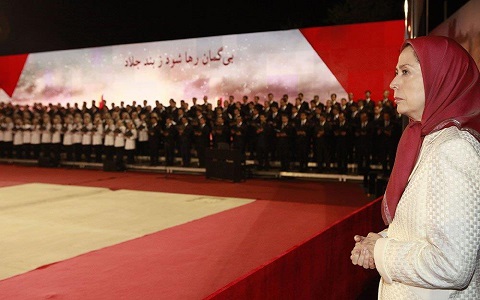
Maryam Rajavi and a number of 
dignitaries at a ceremoney marking the 29th anniversary of the 1988 massacre of political prisoner in
Iran

Every freedom-loving Iranian pays respects to the martyred heroes of the 1988 massacre and honors their memory. The highest and most precious commemoration, however, is what you did by reaching Ashraf from the regime’s torture chambers amid the many mass killings. You bore the scars and the wounds of torture on your bodies, but could not be stopped. You suffered greatly under the regime’s blockade in Ashraf and Liberty and persevered despite your injured bodies.
You recounted the innocence of the victims conveyed their defiance of surrender and their message to everyone.
Indeed, what could be a more effective and appropriate commemoration for those martyrs than what you did?


 The anniversary of the 1988 massacre of 30,000 political prisoners in Iran

Time and again, I have heard you speak of the valiant Mojahdein prisoners who hailed Massoud Rajavi when facing the torturers and executioners. They called out his name while bidding farewell when taken to the gallows.
By repeating this forbidden name, they wanted to not only express their love and faith in Massoud but to send a message to every one of us.


 Maryam Rajavi speaks at the ceremony marking the 29th anniversary of the 1988 massacre of 30,000 political prisoners in Iran.

Their message was to Mojahedin who were continuing their path, to the generation that would follow them and to the youths who would be hearing their unfinished story. And that message was: to follow Massoud Rajavi’s path and ideal, the path of paying the price of freedom, the path of the unrelenting struggle for equality, and the path to fight for a society devoid of oppression, discrimination, ignorance, and duplicity.
The founders of the tradition of standing by one’s ideals
Dear brothers and sisters,


 Maryam Rajavi and a number of dignitaries at a ceremoney marking the 29th anniversary of the 1988 massacre of political prisoner in Iran

Khomeini issued the fatwa for this horrific massacre. In those days, in response to the objections of Hossein Ali Montazeri, his heir apparent at the time, he wrote, 'The religious responsibility of this decree lies with me” and stated his wish for the annihilation of the PMOI/MEK.
But now, history has damned Khomeini has and the Mojahedin are the flames of hope, inspiring freedom.


 Mrayam Rajavi setting flowers at the memorial of the 1988 massacre of political prisoners in Iran

September 6 will mark the 52nd anniversary of the founding of the People’s Mojahedin Organization of Iran. Our founders founded this organization to bring freedom and eradicate of all forms of oppression. To do so, they sacrificed their lives.
They taught their comrades in arm to be the harbingers of new values and lead the way. They also taught us the secret, which is to be truthful and willing to sacrifice.
The PMOI members massacred in 1988 were faithful to this same teaching. They persevered on their stance in the fight against the ruling religious tyranny. They thus founded a tradition which was later called, “standing by one’s ideal.”
Indeed, our movement has survived and thrived because it has stood by its ideal to liberate the people of Iran.


 Maryam Rajavi gestures at the crowd of MEK after a speech on the anniversary of the 1988 massacre of 30,000 political prisoners in Iran

 Iran’s future and the Iranian people’s freedom will be achieved by standing by one’s ideal, namely keeping aloft the flag and paying the price of overthrowing the mullahs’ reactionary Caliphate.
The Martyrs’ Final Message
So, in the memory of those massacred heroes, let us recall some of their final words and messages.
Daryoush Rezaii, born in Mahidasht in Kermanshah, wrote in a poem for freedom:
“O’ freedom! Neither you thirst for blood, nor do we want to shed our own blood. How unfortunate that the evil executioners have drenched the path between us in blood.”
And these are the words of a brave PMOI woman, Zahra Bijanyar, who had been imprisoned for years in Ghezel Hessar Prison, to her relatives


 Maryam Rajavi at a ceremony marking the 1988 massacre of 30,000 political prisoners in Iran

“I have realized that even if the oppressors mutilate our bodies they cannot take our lives so long as we remain steadfast in our beliefs. They can take our lives only when we sell out our faith and hearts. This is the secret to resistance and sacrifice in the history of mankind. Pray to God to bestow me faith and belief so that I would never put that which I desire before His.”
And Ahmad Ra’ouf, from Rasht, said, “They kept beating me all the time and asking me my name. I knew that they knew my name, but I did not tell them anything. I wanted to test myself and see how steel become stained steel.”
Now, let us flash back 29 years, to a scene in the city of Gatchsaran in southern Iran. The body of a young girl was hanging in the city’s main square. It was Massoumeh Barzandeh who was only 20 at the time of her execution. A sign on her clothes said: “She had been a PMOI recruiter.”


 Maryam Rajavi at a ceremony marking the 1988 massacre of 30,000 political prisoners in iran

Massoumeh rose to the Heavens, but she continues to recruit young people for the PMOI. And today, 29 years on, Amnesty International writes in its report that “younger human rights defenders born after the 1979 Revolution” are targeted for “seeking the truth and justice” for the victims of the massacres in the 1980s.
And finally, I want to pay homage to Monireh Rajavi. Throughout her detention, she cared for all her cellmates. She was a selfless and emancipated woman. Let us not forget the words she said to her cellmates in prison: “They want to kill our humanity and this is what we must fight against. We must show our affection toward each other more than ever.”
Let us applaud for one minute for all these heroes and heroines.
The conspiracy of silence is shattered


 A ceremony held at an MEK center in Tirana marking the anniversary of the 1988 massacre of
30,000 political prisoners in Iran.

Dear sisters and brothers, honorable friends,
The Campaign Calling for Justice for the Victims of the 1988 Massacre has expanded over the past year both in Iran and abroad. In response, the clerical regime undertook enormous effort to neutralize this movement. But it has failed miserably.
The mullahs were forced to retreat from their policy of hiding the 1988 massacre. The conspiracy of silence was shattered. The regime’s officials tried to justify this horrendous crime but they could not convince even many of their own clerics to defend the fatwa issued by Khomeini.
Indeed, the prospect of the regime’s overthrow stymied the regime’s supporters and allies. In contrast, many spoke out in defense of the PMOI/MEK. Many opened their eyes and saw the righteousness of the PMOI’s path and ideal such that throughout the past year, the mullahs repeatedly said and wrote that the PMOI/MEK had been vindicated in society.
This was yet another major defeat for the mullahs’ theocratic regime.
After the sham presidential election, when offering an assessment of the state of the regime, Supreme Leader Ali Khamenei’s said the place of victims and executioners had been switched.

 Maryam Rajavi speaks at the ceremony marking the 29th anniversary of the 1988 massacre of 30,000 political prisoners in Iran

Yes, we managed to overcome the regime’s official propaganda s.
Everyone saw that Khamenei had made a major political investment in Ebrahim Raisi, a member of the Death Commission in the 1988 massacre, to become president. But he was defeated by the Call for Justice Movement.
The 1988 massacre is the hallmark of the mullahs’ religious dictatorship. In his first term, Hassan Rouhani appointed Mostafa Pour Mohammadi, a member of the Death Commission, as his Justice Minister. Now, in his second term, he has nominated as Minister of Justice another perpetrator of the massacre in Khuzistan Province. The European Union has already designated and sanctioned this man, Alireza Avayi, for being directly involved in violations of human rights. In reality, none of the regime’s factions can or want to distance themselves from this crime.

  A ceremony held at an MEK center in Tirana marking the anniversary of the 1988 massacre of 30,000 political prisoners in Iran

For this reason, in the past year, a number of the regime’s most disgraced murderers tried to justify the massacre in the face of the Call for Justice Movement. These admissions are among the most important documents incriminating the regime’s leaders. They once again proved that it is the Iranian people’s inalienable right to overthrow the regime.
That you have compelled them to make such admissions represents one of the achievements of the Call for Justice Movement over the past year. These confessions are particularly important because they have been made recently and can therefore provide a solid basis for an international commission of inquiry into the 1988 massacre.
At the same time, it is essential that the UN Security Council refer this case to the International Criminal Court to arrange for the prosecution of the regime’s leaders and those responsible for the massacre.

 Maryam Rajavi and a number of dignitaries at a ceremoney marking the 29th anniversary of the 1988 massacre of political prisoner in Iran

How the international community approaches this genocide and this crime against humanity is a litmus test of its adherence to the principles of human rights. As Massoud Rajavi said years ago, the prose of human society, the people of Iran, and the PMOI/MEK.
Owing to the valuable year-round activities of the Resistance’s network inside Iran, today, we have ample evidence and documents. They include many names of the victims, the names of 112 members of the Death Commission in Tehran and other provinces, nearly all of whom hold key positions in the regime. We also have the names and particulars of 213 criminals who carried out the death decrees in 35 cities as well as the information about the locations of several mass graves that had been previously hidden.
A precious achievement to offer to the Iranian people and all activists of the Call for Justice Movement
The PMOI Investigative Unit has recently acquired the names of hundreds of victims of the massacre in 1988 from inside the country. Each of these names has been thoroughly examined and verified, and their files have been completed. Accordingly, today, we announce the names of 426 members of the PMOI massacred in 1988, but whose names had not been announced previously.


 Maryam Rajavi at a ceremony marking the 1988 massacre of 30,000 political prisoners in Iran

Also, the new edition of the book titled, Crime Against Humanity, has been published in English. It contains the names and particulars of more than 5,000 PMOI martyrs as well as the pictures of hundreds of victims and their graves.
This book is presented to the people of Iran on the eve of the 52nd anniversary of the foundation of the People’s Mojahedin Organization of Iran.
The work by the MEK Investigative Unit is continuing and the names and particulars of many other martyrs are being investigated. Once completed they will be made public.
Here, I would like to call on my fellow compatriots help us in finding new names, pictures and particulars of the martyrs.
I would also like to extend my gratitude to my countrymen and women, particularly the supporters of the PMOI/MEK inside Iran, for their endeavors in the collection of the new names.
Indeed, this tremendous dossier must be made public line by line. It must be made clear what happened in the prisons of Ahwaz, Mashhad, Tabriz, Shiraz, Isfahan, Kermanshah, Qom, and other cities.

 Maryam Rajavi speaks at a ceremony marking the 1988 massacre of 30,000 political prisoners in Iran

Since the first days of this massacre, the regime started to arrest and subsequently execute many supporters of the PMOI/MEK and former political prisoners who were not in prison. It must be determined who were the ones arrested and executed and what happened in the summary trials in western Iran?
At the time, the courts dealing with crimes committed at the war fronts were given a different mission and placed at the service of the regime’s killing machine. Ali Razini, presently a Supreme Court official, and Salimi, a former member of the Guardian Council, are among those who held the summary trials and ordered the execution of several groups of residents in cities in western Iran. They executed youngsters who had assisted the National Liberation Army of Iran. The ruling mullahs, however, have not published any information on those murders and the so-called trials.
Over the past 29 years, we have repeatedly insisted that information on these incidents must be made public.

 Mrayam Rajavi setting flowers at the memorial of the 1988 massacre of political prisoners in Iran

In 1995, the regime had to agree to a visit by the UN Special Rapporteur on the Situation of Human Rights in Iran, Professor Maurice Capithorne.
In a telegram on February 9, 1996, on the eve of Capithorne’s visit, the Massoud Rajavi raised 15 important questions:
How many prisoners has the clerical regime executed so far and how many of them lost their lives under torture?
How many were executed during the massacre of political prisoners in summer and fall 1988, to which even Mr. Hossein-Ali Montazeri, then-Khomeini’s designated successor Protested?
Where were the bodies of those executed buried? Are their families and relatives still not informed of their places of burial and are they not authorized to visit the graves of their loved ones?
And where are the mass graves? How many victims are buried there and what are their names?

 Maryam Rajavi speaks at a ceremony marking the 1988 massacre of 30,000 political prisoners in Iran

Yes, we will not relent until each and every one of these cases are opened and until everyone involved in this crime against humanity is put on trial before the people of Iran.
13 instances of crime and treason committed by the regime
Dear sisters and brothers,
The regime that shed the blood of Iran’s most valiant children, subsequently sanctioned every other crime by violating all ethical and humanitarian principles.
Today, the Call for Justice Movement has shaken the clerical regime to its foundations and is focusing on all of the mullahs’ crimes and treacheries, including:
The mass executions of the 1980s;
The massacres in the Kurdistan of Iran;
The forced dispatch of thousands of teenagers to the minefields during the war with Iraq and other war crimes;

 Maryam Rajavi speaks at a ceremony marking the 1988 massacre of 30,000 political prisoners in Iran
The chain murders of dissident intellectuals;
The assassinations of hundreds of opponents abroad;
The bloody crackdown on the uprising in Qazvin;
The crackdown on the 2009 uprising and the atrocities which took place in Kahrizak Prison;
The systematic assaults on women in prisons;
The mutilation of Christian priests;
The repeated slaughter of our Arab compatriots in Khuzistan;
The bombing of the Holy Shrine of Imam Reza;
The terrorist operations against other countries, including in Mecca, Saudi Arabia;
And the dossiers of seven bloodbaths at camps Ashraf and Liberty in Iraq, especially the massacre of 52 PMOI members on September 1, 2013.
These 13 dossiers, are some of the most important crimes that regime has perpetrated.
The more the Call for Justice Movement advances, the more these dossiers are brought out of darkness.

 Maryam Rajavi speaks at a ceremony marking the 1988 massacre of 30,000 political prisoners in Iran

The Call for Justice is the Iranian nation’s noble campaign to expand the struggle and resistance
The Call for Justice for the victims of the 1988 massacre is a national issue and an indispensable part of the Iranian people’s noble campaign to overthrow the clerical regime.
This campaign seeks to expand the resistance and the battle to bring down the religious tyrannical regime in Iran and establish freedom, democracy, and equality for all citizens.
We salute all those who have risen against the clerical regime. From here, we send our greetings to the political prisoners in Iran, especially those who are presently on hunger strike in Gohardasht Prison. We hail all of them for their determination and resistance.
I am confident that the religious dictatorship ruling Iran will be overthrown by the Iranian people’s uprising and resistance, and with their Army of Freedom and 1,000 bastions of rebellion.
The sacrifices made by our martyrs continue to open the way and guarantee our people’s victory.
God bless you all

Source:MARYAM RAJAVI’SSPEECH ON THE ANNIVERSARY OF 1988 MASSACRE OF POLITICAL PRISONERS IN IRAN

Mattis: Delay in Syria chemical investigation ’unfortunate’

US Defense Secretary Jim Mattis Orient Net, April 19, 2018 -- US Defense Secretary Jim Mattis said on Wednesday (April 18) that a delay i...