 |
Don't whitewash the Iranian regime's crimes
Last week, the Iranian regime took the ambassadors of 45 foreign countries for a tour of the notorious Evin prison in Tehran to judge for themselves how the state treats prisoners. The tour came one day after Javad Larijani, the head of the Iranian regime's so-called "Human Rights Organization," claimed there are no political prisoners in Iran.
This was an attempt to debunk the increasing wave of international criticism at Iran's human rights violations, especially in its prisons.
In the evidently pre-arranged setting, visitors were taken to distinct locations where prisoners were shown to have access to education, media, communications, and work. Disappointingly, some of the attendants, including the ambassadors of Indonesia, Portugal, and South Korea, praised the regime for the humane conditions in its prisons and its treatment of prisoners, according to state-run media.
Meanwhile, political prisoners continue to linger under unbearable conditions in prisons that no foreign diplomat is allowed to visit.
One example is Majid Assadi, a political activist who was arrested by agents of the regime's intelligence ministry on Feb. 18. Assadi was kept in solitary confinement under severe duress for 50 days, and was incarcerated in Evin's wards 209 and 240 for months before being transferred to the Gohadasht prison in Karaj, west of Tehran. Incidentally, his transfer took place a short while before the foreign ambassadors' tour of Evin.
After months, Assadi still awaits to be tried for charges of supporting the opposition group People's Mojahedin Organization of Iran.
Assadi previously served another four-year prison term from 2011 to 2015 for attending a ceremony commemorating the victims of the 1999 student protests in Tehran.
Assadi is one of the countless political prisoners who have suffered or continue to suffer at the hands of the Iranian regime.
The regime's treatment toward dissidents, especially members and supporters of MEK, has been brutal throughout the years. In 1988, in a massive purge of Iran's prisons, the regime executed 30,000 political prisoners, most being linked to MEK. Mostafa Pourmohamadi, Iran's current justice minister, was one of the main orchestrators of the heinous crime. Ebrahim Raisi, a presidential candidate in the recent presidential elections, was another key player in the event that has become known as the "1988 massacre."
Recent years have seen no decline in the harsh treatment of activists and dissidents.
A few weeks ago, Shabnam Madadzadeh, a political activist who recently escaped Iran, gave a harrowing account of the conditions in Gohardasht prison, where Assadi is now being held. During her incarceration, Madadzadeh was threatened to be executed, beaten, deprived of family visits, and phone calls, and she was kept in solitary confinement for long periods.
In 2014, the regime executed political prisoner Gholamreza Khosravi, defying a widespread international campaign to halt the sentence.
In 2012, Sattar Beheshti, a blogger, was tortured to death in Evin prison, the same complex that the foreign ambassadors toured, for having posted online content that criticized the regime's judicial system.
These are just some of the many examples of how the regime treats dissidents. The truth is, the crimes that the Iranian regime has committed against its people and especially in its prisons will not be washed away with any amount of charade setups such as the one it held last week in the Evin prison.
However, whether made out of ignorance or in hopes of currying economic and political favors, the irresponsible remarks made by foreign diplomats will give the regime free rein to continue persecuting, torturing and executing dissidents while it still clings on to power.
The Iranian people will not forget nor forgive the regime's crimes, and will not relent until its officials are held to full account for their atrocities. The least that the international community can do is not to attempt whitewashing the crimes of their murderers.
Amir Basiri (@amir_bas) is a contributor to the Washington Examiner's Beltway Confidential blog. He is an Iranian human rights activist.
If you would like to write an op-ed for the Washington Examiner, please read our guidelines on submissions here.
|
Showing posts with label Karaj. Show all posts
Showing posts with label Karaj. Show all posts
Thursday, July 13, 2017
Don't whitewash the Iranian regime's crimes

Wednesday, July 12, 2017
Why Are Suppression and Arrests Ramping up in Iran?
 |
Iranian political prisoner, Majid Assadi
INU Staff writer, July 9, 2017 - According to reports obtained from inside Iran, the past months have seen a spike in arrests and executions. In fear of mass anti-state protests similar to those that took place in 2009, the regime has resorted to raid the homes of political and human rights activists in Iran, especially the supporters of the main resistance group People’s Mojahedin Organization of Iran (PMOI/MEK).
This happens against the backdrop of a widespread campaign in Iran condemning the regime’s three-decade-long crimes in the country’s prisons, especially the massacre of 30 thousand political prisoners in the summer of 1988. One of the more recent cases is that of Majid Assadi, 34, who lives in Karaj, 40 km west of Tehran. Holding a degree in economics from the Alameh Tabatabai University, Assadi is a student activist, former political prisoner, and a supporter of the MEK. On February 18, 2017 agents of the Ministry or Intelligence and Security (MOIS) arrested Assadi after they violently broke into his father’s home in Karaj. The ten armed MOIS agents arrested Assadi and ransacked his house without any warrant. At the time of the arrest, the agents also harmed Assadi’s ailing father, who had just undergone a liver implant surgery as part of his cancer treatment. The agents handcuffed Assadi in front of his family and interrogated his family in his presence to torment him. They then confiscated all of his personal belongings, including his personal computer, phone and books. Assadi was subsequently transferred to the Karaj intelligence office, and from there to Evin prison’s ward 209, where political prisoners are held. He spent 50 days in solitary confinement, under severe mental pressure and interrogations. Since the time of his arrest, Assadi has been held in a state of limbo. After lingering in wards 209 and 240, he was transferred to Gohardasht prison in recent weeks. According to the latest reports, Assadi is now in Gohardasht and his case remains unsettled. In 2008, Assadi was arrested for attending a ceremony to commemorate the anniversary of the 1999 student protests in Tehran. Assadi was held in solitary confinement for 52 days. In 2010 he was given a four-year prison sentence. His appeal request was rejected, and he was imprisoned from 2011 to 2015. At present, Majid Assadi’s family have called on human rights organizations and other relevant international bodies to help save his life and deliver him from the dungeons of the Iranian regime, where human rights activists are executed and tortured to keep the mullahs in power. |
Monday, July 10, 2017
WHY ARE SUPPRESSION AND ARRESTS RAMPING UP IN IRAN?
 |
WHY ARE SUPPRESSION AND ARRESTS RAMPING UP IN IRAN?
INU - According to reports obtained from inside Iran, the past months have seen a spike in arrests and executions. In fear of mass anti-state protests similar to those that took place in 2009, the regime has resorted to raid the homes of political and human rights activists in Iran, especially the supporters of the main resistance group People’s Mojahedin Organization of Iran (PMOI/MEK).
This happens against the backdrop of a widespread campaign in Iran condemning the regime’s three-decade-long crimes in the country’s prisons, especially the massacre of 30 thousand political prisoners in the summer of 1988.
One of the more recent cases is that of Majid Assadi, 34, who lives in Karaj, 40 km west of Tehran. Holding a degree in economics from the Alameh Tabatabai University, Assadi is a student activist, former political prisoner, and a supporter of the MEK.
On February 18, 2017 agents of the Ministry or Intelligence and Security (MOIS) arrested Assadi after they violently broke into his father’s home in Karaj.
The ten armed MOIS agents arrested Assadi and ransacked his house without any warrant.
At the time of the arrest, the agents also harmed Assadi’s ailing father, who had just undergone a liver implant surgery as part of his cancer treatment.
The agents handcuffed Assadi in front of his family and interrogated his family in his presence to torment him. They then confiscated all of his personal belongings, including his personal computer, phone and books.
Assadi was subsequently transferred to the Karaj intelligence office, and from there to Evin prison’s ward 209, where political prisoners are held. He spent 50 days in solitary confinement, under severe mental pressure and interrogations.
Since the time of his arrest, Assadi has been held in a state of limbo. After lingering in wards 209 and 240, he was transferred to Gohardasht prison in recent weeks.
According to the latest reports, Assadi is now in , and his case remains unsettled.
In 2008, Assadi was arrested for attending a ceremony to commemorate the anniversary of the 1999 student protests in Tehran. Assadi was held in solitary confinement for 52 days.
In 2010 he was given a four-year prison sentence. His appeal request was rejected, and he was imprisoned from 2011 to 2015.
At present, Majid Assadi’s family have called on human rights organizations and other relevant international bodies to help save his life and deliver him from the dungeons of the Iranian regime, where human rights activists are executed and tortured to keep the mullahs in power.
|
Help the Iranian People to Oust Their Oppressive Regime
 |
|
The new Trump administration in Washington is still grappling with the extent to which it is obligated to uphold the illegitimate Joint Comprehensive Plan of Action (JCPOA) -- the nuclear deal that the five members of the UN Security Council plus Germany signed with each other in July 2015, and apparently never signed by Iran. While the Trump administration is saying that military action is not off the table, grassroots efforts by Iranian expatriates to help their brethren inside the Iran to topple their repressive regime have been underway.
These efforts were on full display recently on July 1 in Paris, France, where an estimated 100,000 Iranian dissidents and hundreds of politicians and other world dignitaries attended an annual "Free Iran" rally. The event, titled "Onward with the Iranian Resistance, Regime Change within Reach," expressed the feelings of courageous young people in dozens of Iranian cities, where they braved the menacing presence of members of the regime's intelligence services to show support for the rally in Paris.
Across Tehran, Mashhad, Isfahan, Shiraz, Karaj, Tabriz, Ahwaz and other areas, Iranians expressed their discontent on the walls of buildings. The Iranian people denounced Iran's Supreme Leader Ali Khamenei and hailed a 10-point plan devised in 2006 by Maryam Rajavi -- co-head of the People's Mojahedin of Iran (PMOI) and president-elect of the Paris-based National Council of Resistance of Iran (NCRI) -- for the future of their country. They also distributed leaflets in support of the Paris gathering, and shared hundreds of photos and videos on social media. The rally itself was streamed live on the internet and watched by thousands of viewers.
Speaking at the event, former Speaker of the U.S. House of Representatives Newt Gingrich said:
Gingrich was alluding to the last time there was an internal attempt to oust the mullah-led regime in Tehran. In the summer of 2009, after the announcement that Iranian President Mahmoud Ahmadinejad had defeated opposition candidate Mir-Hossein Mousavi, head of the Green Movement, in the presidential election, tens of thousands of people poured into the streets and accused Ahmadinejad of stealing the election.
After going through the motions of investigating this claim, Khamenei declared that the election had been "completely free," and that Ahmadinejad was the legitimate victor.
When Iranians from various sectors took to the streets to protest, the regime's paramilitary Basij militia responded violently, beating and gunning down demonstrators. Thousands of people were arrested and sent to prison, and the regime blocked access to the internet, which had been the vehicle through which protesters shared cellphone videos of their ordeal, and enabled the world to see what was happening to them.
The Obama administration, which was already working with other world powers to negotiate the nuclear deal with Iran, responded by adopting a neutral stance. At a press conference 11 days after the election in Iran, then-U.S. President Barack Obama stated:
These efforts were on full display recently on July 1 in Paris, France, where an estimated 100,000 Iranian dissidents and hundreds of politicians and other world dignitaries attended an annual "Free Iran" rally. The event, titled "Onward with the Iranian Resistance, Regime Change within Reach," expressed the feelings of courageous young people in dozens of Iranian cities, where they braved the menacing presence of members of the regime's intelligence services to show support for the rally in Paris.
Across Tehran, Mashhad, Isfahan, Shiraz, Karaj, Tabriz, Ahwaz and other areas, Iranians expressed their discontent on the walls of buildings. The Iranian people denounced Iran's Supreme Leader Ali Khamenei and hailed a 10-point plan devised in 2006 by Maryam Rajavi -- co-head of the People's Mojahedin of Iran (PMOI) and president-elect of the Paris-based National Council of Resistance of Iran (NCRI) -- for the future of their country. They also distributed leaflets in support of the Paris gathering, and shared hundreds of photos and videos on social media. The rally itself was streamed live on the internet and watched by thousands of viewers.
Speaking at the event, former Speaker of the U.S. House of Representatives Newt Gingrich said:
"The next time there's popular dissent, it will be across the whole country; it will be organized. The Trump administration needs to be prepared and leaning forward and ready to do everything it can to help freedom win and dictatorship lose in the great struggle that is underway in Iran."
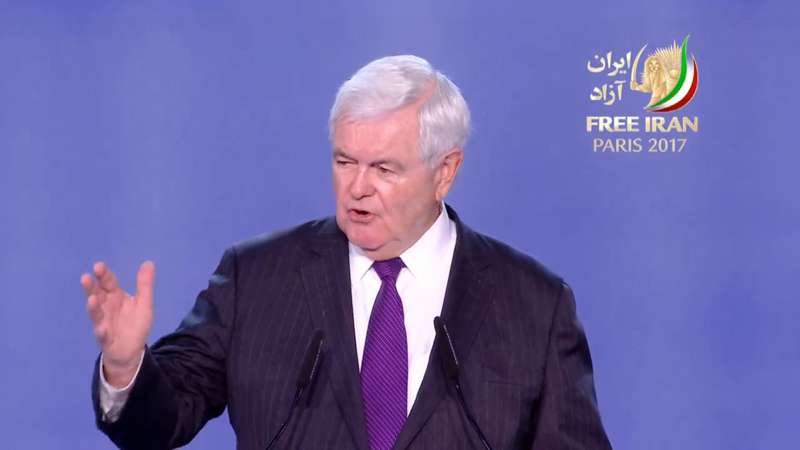
Newt Gingrich, former Speaker of the U.S. House of Representatives, addresses the "Free Iran" rally on July 1 in Paris, France. (Image source: National Council of Resistance of Iran video screenshot)
|
Gingrich was alluding to the last time there was an internal attempt to oust the mullah-led regime in Tehran. In the summer of 2009, after the announcement that Iranian President Mahmoud Ahmadinejad had defeated opposition candidate Mir-Hossein Mousavi, head of the Green Movement, in the presidential election, tens of thousands of people poured into the streets and accused Ahmadinejad of stealing the election.
After going through the motions of investigating this claim, Khamenei declared that the election had been "completely free," and that Ahmadinejad was the legitimate victor.
When Iranians from various sectors took to the streets to protest, the regime's paramilitary Basij militia responded violently, beating and gunning down demonstrators. Thousands of people were arrested and sent to prison, and the regime blocked access to the internet, which had been the vehicle through which protesters shared cellphone videos of their ordeal, and enabled the world to see what was happening to them.
The Obama administration, which was already working with other world powers to negotiate the nuclear deal with Iran, responded by adopting a neutral stance. At a press conference 11 days after the election in Iran, then-U.S. President Barack Obama stated:
"I think it is not too late for the Iranian government to recognize that there is a peaceful path that will lead to stability and legitimacy and prosperity for the Iranian people. We hope they take it."Of course, the theocratic regime in Tehran did not then, and does not now. It is imperative for members of the Trump administration to heed Gingrich's words, and not repeat the behavior of their predecessor. It is not only the well-being of the Iranian people that is at stake, but the safety and security of the free world.
Hassan Mahmoudi is a human rights advocate, specializing in political and economic issues relating to Iran and the Middle East. Twitter: @hassan_mahmou1
© 2017 Gatestone Institute. All rights reserved. The articles printed here do not necessarily reflect the views of the Editors or of Gatestone Institute. No part of the Gatestone website or any of its contents may be reproduced, copied or modified, without the prior written consent of Gatestone Institute.
Subscribe to:
Posts (Atom)
Mattis: Delay in Syria chemical investigation ’unfortunate’
US Defense Secretary Jim Mattis Orient Net, April 19, 2018 -- US Defense Secretary Jim Mattis said on Wednesday (April 18) that a delay i...

-
By Tony Duheaume Special to Al Arabiya EnglishSunday, sunday, 30 July 2017 The Iranian regime lives in constant fear of an upris...
-
 “US officials should worry more about saving their own regime than changing Iran’s,” June 26, 2017 -- As the new administra...
 -
 Iran Focus London, 30 Jun - The Former European Parliament Vice-President Alejo Vidal-Quadras has warned that the West needs to be m...
